A Modest Proposal for the Future of Copyright in the AI Age
By Brent C.J. Britton
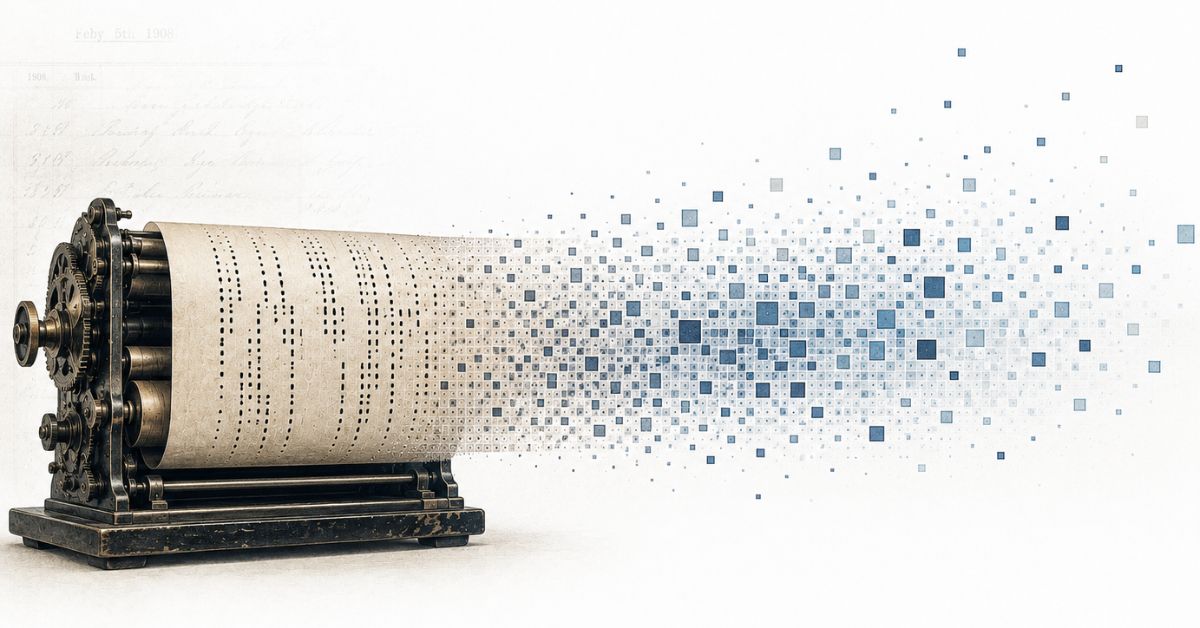
In February 1908, the Supreme Court decided that a player piano roll was not a “copy” of the song it played. A roll of perforated paper, the Court reasoned, was part of the machine that produced the music, no more an infringement of the composer’s rights than the piano’s hammers or strings, or the gramophone’s turntable.
Songwriters were furious, and Congress agreed with them enough to rewrite copyright law within the year. The result, tucked into the Copyright Act of 1909, was the first compulsory license in American law: anyone could now press a piano roll or a phonograph record of a published song without asking the composer’s permission, so long as they paid a fixed royalty (two whole cents a copy, nearly 75 cents today) into a fund the composer had no power to refuse. It was, at the time, a genuinely radical concession to a market dynamic nobody entirely understood yet.
It is also, whether Washington D.C. remembers it or not, close to the exact shape of the argument I want to make about artificial intelligence.
I’ve Seen This Movie Before
I have spent more than 30 years practicing intellectual property law, which is long enough to have watched this particular movie play more than once. When Napster turned ripping compact discs into an online business model, the professional class of alarmists insisted that copyright law, built for a world of physical records, could not possibly survive contact with the internet.
It survived.
The law did not need reinventing. It needed enforcing, and once courts got around to it, that is exactly what happened.
A decade or two later, when blockchain technology and Bitcoin promised a form of money no government could touch, the same alarm sounded, and the same thing happened: everyone had simply forgotten, or preferred not to remember, that the Securities and Exchange Commission and the Internal Revenue Service already had a great deal to say about instruments that resemble securities and property that generates taxable gains. Eventually, they said so, at considerable volume.
Most of the time, the claim that a new technology changes everything turns out to mean only that the old law was slow to catch up, not that the old law failed to apply.
But… artificial intelligence is not that.
A large language model does something categorically new: it ingests the entire corpus of, well, all copyrighted works in a single training run, compresses the patterns of all of them into a bunch of statistical weights and parameters, and then generates new works that potentially compete directly in the market for the very works it consumed, and it does this across borders faster than any single court or regulator can follow.
And on the other side of that transaction sits a second, quieter problem: unlike a pirated mp3 or a misclassified security, most of what the model then produces is not copyrightable at all, since courts on both sides of the Atlantic have already ruled that only a human being can be an author.
That is not a scale of infringement copyright law was ever built to police. So copyright is creaking under this new weight like the beams and columns of a poorly renovated skyscraper. It is the reason any workable fix has to be structural, an actual piece of legal machinery, rather than the accumulated residue of a decade of lawsuits.
Six Governments, Six Answers, No Coordination
No two governments have answered the resulting questions the same way, and nobody appears to be comparing notes.
The United States, true to form, is doing this exclusively through litigation, one dispute at a time, with results that flatly contradict one another.
The United Kingdom drafted a rule, called it the government’s clear preference, and then spent a year quietly backing away from it, until ministers stood up in the House of Lords and admitted, in public, that they had been wrong to prefer it in the first place, a reversal so complete it brings to mind the Monty Python bit about the castle that burned down, fell over, and sank into the swamp.
Britain’s actual position at the moment is that it does not have one, and Getty Images has already lost its own lawsuit trying to convince a British court that a trained model is the legal equivalent of a stolen photograph, so the resulting vacuum currently favors the machines by default.
It seems that AI’s internal model weights and parameters are, as a matter of UK law, piano rolls.
The European Union, characteristically, wrote something down: a technical opt-out regime under which AI companies may train on anything unless a rightsholder plants a digital “keep out” sign in machine-readable form, the closest thing to an actual rule anywhere on earth, and one its own Parliament is already on record calling insufficient.
Australia looked at copying the European approach, didn’t care for it, and declined on the theory, expressed about as bluntly as governments ever manage, that letting technology companies mine copyrighted work for free simply because it is technically possible is not policy but surrender, and sent its regulators back to design a licensing system instead.
India went furthest of all, drafting a mandatory blanket license so sweeping that it acquired its own nickname, “one nation, one licence [sic], one payment,” compulsory licensing at the scale of an entire country, and the rest of the world is watching closely to see whether it works.
Japan, with characteristic comity, has quietly permitted all of this, without fuss and without a fight, since 2018, and its own newspaper publishers are only now beginning to wonder aloud whether that was a mistake.
China, in the meantime, is fighting a different war entirely: its courts have twice held that an AI-generated image can be copyrighted if the human being who prompted it can document real creative effort, an answer American and British courts have flatly rejected.
The Courts Cannot Agree, Because the Law Was Never Built for This
Back in the U.S., three federal rulings arrived within a single year, and produced three incompatible verdicts.
A judge in Delaware told Ross Intelligence that it had infringed Thomson Reuters’s copyrights by training a legal-research tool on Westlaw’s headnotes, headnote by headnote, precisely because the tool had been built to compete with the very product it learned from. (Besides, silly wabbit, every lawyer knows that Westlaw’s headnotes are untouchably proprietary.)
A judge in California told Anthropic the opposite: training a model on legally purchased books was, in his honor’s words, quintessentially transformative fair use, even as the very same ruling found that downloading pirated copies of those same books from shadow libraries was not fair use at all, a distinction that cost Anthropic $1.5 billion, the largest copyright settlement in American history, and that resolved absolutely nothing about anyone else’s case.
A judge in New York, meanwhile, allowed a novel theory to proceed: that ChatGPT’s own summaries of copyrighted novels can themselves infringe, on their own terms, and the Times is now accusing OpenAI of lying to the court about what it is capable of searching in its own records.
On exactly one question is there a final answer. The Supreme Court closed the door in March of 2026: artificial intelligence cannot hold a copyright, regardless of how the output was produced. Everything else remains three courts, three tests, and three results that refuse to add up to a single, coherent rule.
The Golden Rule: They Who Have the Gold Make the Rules
While courts and legislatures work through the theory, a quieter process is already settling the question in practice, for anyone with enough leverage to negotiate directly. OpenAI alone has signed something like two dozen publisher licensing deals, with the Associated Press, Axios, the Guardian, the Washington Post, and others, trading access to their archives for money, attribution, and product placement. These deals grow larger and more numerous every year. They are also available exclusively to publishers substantial enough to possess something an AI company actually wants, and a sufficiently well-lawyered negotiating team to extract a fair price for it.
The individual novelist, the freelance photographer, the local paper down to its last three reporters: none of them are being offered anything. Left to its own devices, the market resolves this problem entirely in favor of the largest rightsholders, which is more or less the outcome that should worry anyone who has watched what happens to collective licensing over a long enough timeline. Performing rights organizations in the music industry have spent decades fielding credible complaints that their distribution formulas quietly favor already successful writers over the far larger population of working musicians who never quite break through. A voluntary marketplace and an underfunded collecting society, it turns out, arrive at the identical result from opposite directions: the biggest players get paid, and everyone else receives a rounding error.
What We Should Actually Want a Copyright System to Do
Before endorsing any particular fix, it is worth pausing to say plainly what a fix ought to accomplish, because nearly every proposal currently in circulation fails at least one of the following tests without anyone quite admitting it out loud.
First, it has to pay individual creators, not merely the publishers substantial enough to negotiate their own terms. A regime that functions only for organizations with a name on a building is not solving the underlying problem. It is simply formalizing who already wins.
Second, no single content owner should be able to hold the entire system hostage. If one publisher, one record label, or one industry association can withhold its catalog, drag out a lawsuit indefinitely, or simply walk away from the table and freeze payment for every other creator standing behind it, the system contains a single point of failure dressed up as a protection for rightsholders.
Third, the system cannot depend on litigation as its enforcement mechanism. A right that means something only if you can fund years of federal litigation is a right that exists, in practice, for the New York Times, and for almost no one else.
Fourth, it should not hand additional leverage to the largest players on either side of the transaction, not to the handful of AI laboratories wealthy enough to buy their way into exclusive licensing arrangements, and not to the handful of media conglomerates and collecting societies large enough to dictate the terms those arrangements are built on.
Fifth, the system has to be auditable rather than merely declared. A distribution formula tied to actual usage means nothing if no one can verify what a model was actually trained on. Transparency requirements need a real audit behind them, not a disclosure checkbox nobody ever checks.
Sixth, it cannot quietly extinguish the incentive to keep creating in the first place. A right to be paid is not the same thing as a right to negotiate what a particular work is actually worth, and a flat statutory fee untethered from real demand risks paying every creator roughly the same trivial sum, regardless of whether anyone is actually using their work.
Seventh, it cannot be evaded simply by moving the server. A rule that reaches only AI companies training within one country’s borders is a rule that a more permissive jurisdiction can simply absorb, since a model trained somewhere lax can still be sold everywhere else.
Judge every proposal on the table against those seven obligations, not against how elegant it sounds in a law review article.
Why the Obvious Answers Keep Failing
Run the current menu of proposals against those seven obligations and most of them collapse quickly. Leaving the market to sort itself out serves only the rightsholders substantial enough to negotiate their own arrangements. Allowing litigation to keep deciding the question case by case works reasonably well for anyone capable of absorbing a nine-figure settlement, and starves out everyone who cannot. The European opt-out model presumes a degree of technical sophistication most individual creators simply do not possess, and still permits a single sufficiently large publisher to gum up the machinery for everyone standing behind it.
The more institutional proposals fare no better. A blanket license administered by a private collecting body, modeled on the music industry’s ASCAP and BMI, merely relocates the leverage problem indoors: any member large enough to credibly threaten withdrawal can extract better terms than everyone else remaining in the pool.
An industry consortium modeled on a patent pool suffers the identical flaw from a different angle, since it exists only because the largest AI laboratories and the largest publishers agreed to build it in the first place, which means those same players write the rules of entry, and any one of them can walk away from the table and stall the whole arrangement for everyone still waiting to be paid.
The Fix That Actually Clears the Bar
What is left, I would argue, is a compulsory license, though not the vague abstraction that phrase usually conjures in policy papers. American law has built this kind of machinery before, more than once, and it has worked reasonably well each time.
The 1909 Act gave every songwriter a guaranteed two cents a copy whether they wanted to negotiate or not. The consent decrees that settled the government’s 1941 antitrust suits against ASCAP and BMI created a rate court, still sitting in the Southern District of New York today, whose entire job is to set a reasonable price when a broadcaster and a rights organization cannot agree on one themselves. Section 111 of the 1976 Act did the same thing for cable television, letting cable operators retransmit broadcast signals automatically, in exchange for a statutory fee nobody has to individually negotiate.
And in 2018, Congress built the closest thing yet to a dress rehearsal for this exact problem: the Music Modernization Act threw out the old song-by-song mechanical license and replaced it with a single blanket license covering every musical work eligible for compulsory licensing, administered by a new body called the Mechanical Licensing Collective, whose entire job is to take in usage reports from streaming services, work out who actually wrote what, and pay them, automatically, without anyone having to fill out an application first.
None of these fixes were popular with rightsholders at the time they were enacted. All of them are now considered, a century or, in the newest case, a handful of years later, unremarkable furniture in copyright’s pantheon. The version worth building for artificial intelligence borrows directly from that lineage, and adds only the features that lineage never had to consider.
The AI copying rate should be set by a government tribunal or regulator, in the manner cable retransmission rates have long been set, rather than negotiated bilaterally, so that no AI company can buy its way to an advantage and no rightsholder association can hold out for better terms than its competitors receive. Every AI developer training a general purpose model above a modest size threshold should pay that same rate for the same access, automatically, with no individual negotiation and no lawsuit required to trigger payment. The resulting funds should be distributed through a public fund rather than a privately governed collecting society, on a formula tied to actual, disclosed usage rather than market share or publisher size, which only functions if the training-data transparency requirements the European Union’s AI Act already imposes are treated as load-bearing rather than decorative. And the license should cover individual creators automatically, with no opt-in application process quietly filtering out everyone who never learned it existed, precisely the failure mode the Mechanical Licensing Collective already exists to correct for songwriters whose royalties would otherwise sit unclaimed for want of a registration nobody told them to file.
Three further features answer the obligations a 1909 Congress never had to think about. An independent auditor, not the AI companies themselves, should verify the training-data disclosures the entire license depends on, since usage-based distribution is meaningless without real verification behind it, the same verification problem the Mechanical Licensing Collective now solves daily by matching streaming reports against a registry of ownership before a single check goes out. The tribunal should re-benchmark its rate on a fixed schedule against whatever voluntary deals continue to be struck in the open market, the Associated Press’s arrangement with OpenAI, the Guardian’s, and so on, so the statutory rate cannot drift permanently below what genuine bargaining is already producing. And liability should attach to where a model is sold and deployed, not to where it happened to be trained, so that no company can train quietly in a permissive jurisdiction and still sell freely into every market that adopted a compulsory license of its own.
Boring and mechanical, but fair. Mostly.
It is worth being honest, in a way the piano-roll composers of 1909 were rarely permitted to be, about where this still leaves real tension unresolved. A compulsory license is only as fair as the rate-setting process behind it, and rate tribunals are exactly the sort of low-visibility forum that well-funded lobbying tends to capture quietly over the span of a decade. Nor does the sixth obligation ever fully resolve: the very feature that prevents any single rightsholder from holding the system hostage, the fact that nobody can refuse the license, is the same feature that caps what a uniquely valuable work can ever earn relative to what a genuine negotiation might produce. Benchmarking against market deals narrows that gap. It does not close it. Any workable design has to assume the pressure will eventually arrive, and build its audits to survive that pressure, rather than assuming good behavior from whoever happens to show up at the first hearing.
Every business that touches artificial intelligence right now, the ones licensing their content out, the ones training the models, the ones simply trying to determine whether their own copyrighted material is already at risk, is operating inside a legal landscape whose eventual rules have not yet been written.
Nobody asked permission before any of this started. Nobody asked the music composers or the piano-roll makers for permission in 1908 either. Congress simply decided who was going to pay, and to whom, and copyright law has been boring and fair about it ever since.
It’s time to be boring and fair again.
About the Author
Brent C.J. Britton is the Founder and Principal Attorney at Brent Britton Legal PLLC, a law firm built for the speed of innovation. Focused on M&A, intellectual property, and corporate strategy, the firm helps entrepreneurs, investors, and business leaders design smart structures, manage risk, and achieve legendary exits.
A former software engineer and MIT Media Lab alum, Brent sees law as “the code base for running civilization.” He’s also the co-founder of BrentWorks, Inc., a startup inventing the future of law using AI tools, and is the author of Ownability.