By Brent C.J. Britton
Here is something worth a gander: we may be in the process of moving the entire creative output of human civilization into the public domain, doing so with breathtaking efficiency and no meaningful legal barrier in sight.
Basically, AI is hoovering up all the copyrighted content and recasting it as un-ownable derivatives in the public domain.
Fun, right?
How Copyright Works
Copyright law rests on a simple and elegant premise. When a human being creates an original work, that work belongs to its creator. The right vests at the moment of creation, without any need for registration or other formality. Write a poem, take a photograph, compose a song, and the copyright belongs to you automatically.
The key word in that paragraph is human.
Copyright, under U.S. law, and virtually every other copyright system in the world, requires a human author. The Copyright Act protects “original works of authorship,” and both the courts and the U.S. Copyright Office have consistently interpreted that phrase to mean works created by people. Not machines. Not animals. People.
This is a foundational principle. The rationale for copyright stems from the Constitution’s mandate to encourage human creativity by rewarding creators with a limited period of exclusive ownership. Remove the human author from the equation and the rationale begins to dissolve along with the rights themselves.
What AI Actually Does
Every major AI language model and image generator in existence today was trained on data at a staggering scale. That training data includes billions of books, articles, photographs, songs, screenplays, source code repositories, and countless other creative works, virtually all created by human beings (sometimes on behalf of their employers) who own the copyrights in them, and many of whom never consented to having their work incorporated into commercial AI training datasets.
The AI does not simply read those works and set them aside.
It absorbs them.
It encodes linguistic patterns, relationships, styles, and structures derived from the underlying material into billions of numerical parameters. When prompted to create something new, the model synthesizes an output by drawing on everything it learned from everything it ingested. The resulting work is, in a meaningful sense, a statistical derivative of the copyrighted material that came before it.
Now here is where it gets interesting.
The AI-generated output does not legally belong to anyone.
The company that built the model does not own it. Neither does the person who typed the prompt. The human creators whose works helped train the model certainly do not own it either.
Under current law, no one owns it. It falls into the public domain the moment it is generated, because no human authored it.
The Copyright Office has said so repeatedly, and courts have increasingly reached similar conclusions. Raw AI-generated content, absent meaningful human creative contribution, is simply not copyrightable.
It is born unowned. A public good. In the commons. A ghostwritten ghost. A mashup with no DJ.
The Laundering Effect
Step back and look at what this process actually accomplishes.
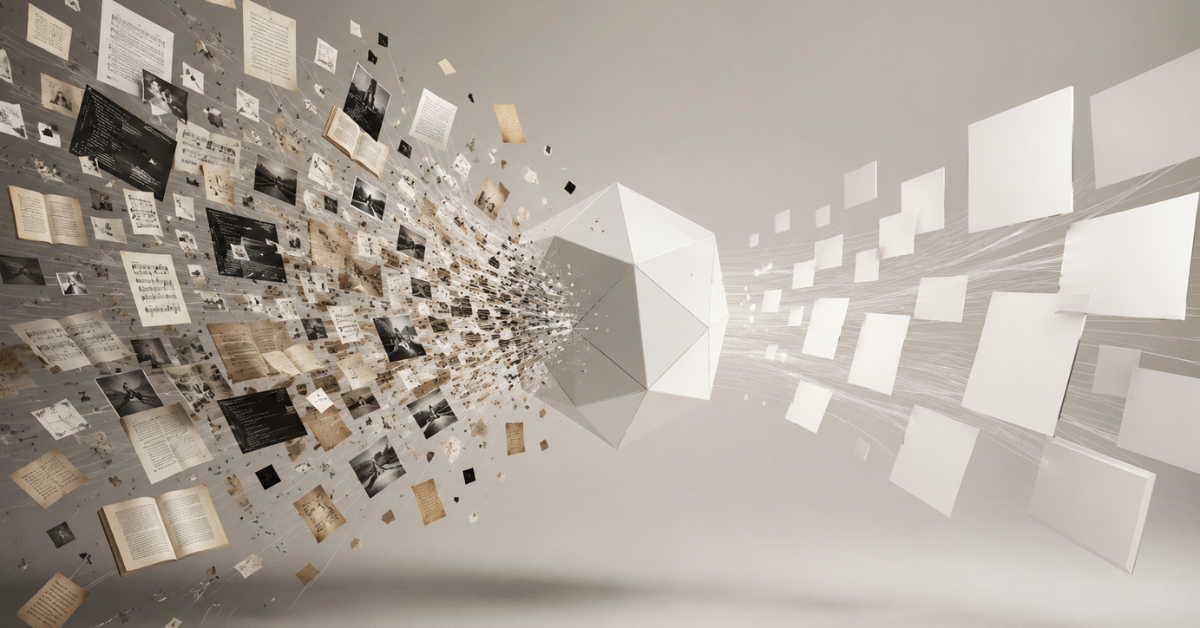
Basically the entire corpus of humanity’s proprietary, copyrighted content goes into one end of the machine.
Uncopyrightable output comes out the other.
That is what I mean by copyright laundering.
It is the industrial-strength transformation of proprietary creative assets into ownerless content. At global scale, continuously, and around the clock.
Unless they have managed to work out a deal with one or more of the AI providers, the original authors whose works constitute the raw material receive no licensing fees or other compensation for this. No royalties flow to the musicians whose recordings helped train music generators, the novelists whose prose informed language models, or the photographers whose images trained image generators.
Their creative work is absorbed, processed, and returned to the world in a form that cannot itself be owned by anyone, least of all the people whose work made it possible.
The word laundering is not merely a colorful metaphor here.
Money laundering takes proceeds with a legally problematic origin and runs them through a process that strips away their previous legal character before returning them to circulation in a form that appears clean.
Something remarkably similar may be happening here, or rather, its inverse.
The AI is the washing machine.
Clean copyrighted training data goes in. Like, all of it.
Uncopyrightable slop comes out.
The End State
If you are fond of the creative commons or an advocate for the copyleft philosophy, you may regard the wholesale lifting of the copyright yoke from global content to be a big win for the repurposing lobby. But consider where this leads over time.
Every major category of creative work is already being flooded with AI-generated material: news, fiction, music, visual art, marketing copy, legal documents, scientific papers, software, and social media content.
As AI-generated material accumulates, it becomes training data for the next generation of models. Those models produce still more AI-generated content, which in turn becomes additional training data.
Over successive generations, the signal contributed by original human-authored works becomes increasingly diluted in the AI-generated noise.
At the same time, the economic incentive to invest in original human creativity steadily erodes. Why commission a novel if a model can generate something functionally similar for almost nothing? Why pay an illustrator when unlimited variations can be produced instantly?
The incentive structure copyright was designed to create, the very one the Framers intended to encourage innovation, begins to weaken.
The irony is difficult to ignore.
Some of humanity’s greatest creative achievements are being used, without compensation or consent, to build systems that may ultimately reduce the economic value of human creativity itself.
The Uncomfortable Question
None of this means AI-generated content is inherently bad, nor does it diminish the extraordinary utility of artificial intelligence.
But the copyright implications of AI at scale represent a structural disruption that the law, and I daresay society, has not yet fully confronted.
The creative community whose work was used to train these models has a legitimate grievance. The companies building the models have profited enormously from a form of input acquisition that, to put it charitably, has operated in a legal gray zone. Meanwhile, the public will increasingly consume AI-generated content without knowing, or caring, that no human being authored it, inheriting a creative landscape that may look very different from the one we have today. An inevitably duller one, it would seem. Pity.
Do we intend, as a society, to allow the intellectual property created by generations of human authors to be processed through machines and returned to the world, in its essence, as content belonging to no one in particular?
Because at present we are sleepwalking into a future where the human signature is being systematically stripped from our culture, leaving us with a world that is technically efficient, but soulless.
About the Author
Brent C.J. Britton is the Founder and Principal Attorney at Brent Britton Legal PLLC, a law firm built for the speed of innovation. Focused on M&A, intellectual property, and corporate strategy, the firm helps entrepreneurs, investors, and business leaders design smart structures, manage risk, and achieve legendary exits.
A former software engineer and MIT Media Lab alum, Brent sees law as “the code base for running civilization.” He’s also the co-founder of BrentWorks, Inc., a startup inventing the future of law using AI tools, and is the author of Ownability.